
















FFAC, a Federation for most guide dog schools in France
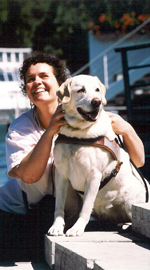 Access rights for guide dogs
The French Federation of Guide Dog Associations (FFAC) FFAC is a charity gathering guide dogs schools in France. Our common aim: provide the visually impaired with guide dogs as a mean for a safe independence and a better integration in society. It helps and coordinates:
- 10 main regional schools managing 17 training centres;
- 1 national Guide Dog Users Association (ANMCGA);
- 1 school for children and teen-agers (Fondation Frédéric GAILLANNE);
- 1 breeding network for puppies:
- 1 national breeding centre (CESECAH) at Lezoux (63),
- The Puppy House at Angers (49),
- The breeding and training centre Jacques Bouniol at Buc (78).
FFAC and FFAC members are also IGDF members. They follow a code of good practice. They exclusively live on donations and legacies.
Our main missions
- Help schools in their actions
- Communicate on the benefits of guide dogs
- Bring financial support to members
- Organize and pay for the vocational training of guide dog mobility instructors (state-approved since 2002)
- Organize national campaigns on guide dogs access rights
- Organize meetings with members on goods practices on different topics like accounting and social rules, fundraising, technical questions, communication, veterinary researches
Guide dogs in France
In 2016, 222 guide dogs were granted; 204 in 2015. 1500 qualified units are currently at work.
5000 guide dogs were given since 1967.
The average age for getting a first guide dog is 52. Dogs are generally 2 years old when they are matched.
Breeding, training and matching a guide dog means a significant cost for the schools but guide dogs are given for free to the visually impaired persons.
The initiators
Paul Corteville trained the first guide dog in France in 1952 for a blind friend. Paul Corteville was also responsible for the creation of the first School in France near Lille whilst another School was created near Nice, in the South of France, by Joseph Micoud. The two men initiated the French Federation of Guide Dog Associations (F.F.A.C.), created in 1972.
Guide dog services delivery
All guide dogs pass the same qualification all over France
After a training of 6 months or more (even 2 years), guide dogs are granted to the visually impaired people. An ID card is delivered for the guide dog, allowing access everywhere, even to the butcher’s!
Instructors provide an aftercare during the active life of the guide dog (between 8 and 10 years), prepare owners to retirement and allocation of a new guide dog.
Guide dog mobility instructors' training in France
Students are sent to training by the Guide Dog Schools who employ them and ensure their practical training. Each student is followed by a tutor in his School. An A-level is necessary prior to training.
The training lasts 4 years (2 years to become a trainer and 2 more years to become an instructor). 10 to 16 students (for all Member Schools) are currently trained per annum.
Theoretical modules take place in several specialised training centres: a dog-specialised university and the O&M Training Centre.
The curriculum includes knowledge of visual impairement and Orientation and Mobility techniques, canine biology and behaviour, veterinary care, breeding, guide dog training, social sciences, information technologies, English...
Lobbying actions
ANMCGA and FFAC organize national lobbying to promote access for guide dogs and legal measures :
- Since 80’s lobbying for free access in shops and public transport
- In 2002, the Federation’s training for guide dog instructors was state-certified.
- In 2004-2005 The Federation took part in the preparation of the Handicap Act, which resulted in an official recognition of guide dogs and the creation of a label for guide dog schools.
- In 2012-2013: FFAC carried out the first survey into guide dog accessibility and continues campaign for access for all.
- In 2015 the Observatory of Guide Dogs Access (OBAC) was created to inform professionals and promote good practice.
Access rights for guide dog users
Where can I go with my guide dog in France? Can I use public transports?
The Law of 11 February 2005 guarantees free access for guide dog users to all places and facilities open to the general public: public buildings and transports, shops, hotels, restaurants, museums, etc. Sanitary restrictions limit access to rooms and care units in hospitals, kitchens in catering facilities, etc. It may also be requested that guide dogs be muzzled in air transports.
You can be required to show your disability card and a document identifying your dog as guide dog. The French Federation can deliver a temporary card in French to guide dogs from IGDF Members upon request. Puppy walkers and instructors enjoy the same rights but the legislation is relatively recent.
Free access does not mean absence of rules. You could be denied access if he/she does not behave. Do not let him/her run all over the place in restaurants or on the beach, jump on the seats in taxis or sleep on your bed in hotels!
However it may happen that your interlocutors are unaware of guide dogs access rights. The best attitude is to inform them, a smile being your best advocate! Guide dogs are usually welcome and much admired. If negotiation proves unfruitful, call for the police (dial 17) so the trespassing is recorded and report the case to the French Association of Guide Dog Users. Refusing access to a place open to the public is repressed by a € 305 fine.